Floor Lamp Inverse Square Law Explained: Why Light Dims Fast
If you’ve ever set up a bright new floor lamp only to find it casts a weak, useless pool of light across your reading chair, the floor lamp inverse square law explained in this guide will fix that confusion fast. Most people assume a higher lumen count automatically means brighter light at any distance, but that’s not how light physics works. We’ll break down exactly how brightness drops as light moves away from your lamp, no physics degree required.
This is all practical, real-world info you can use tonight to get better lighting.
Per Illuminating Engineering Society (IES) testing standards, reading tasks require 300 to 500 lux of illuminance to avoid eye strain, but most people place floor lamps too far from their seating to hit that mark. We’ll walk through exactly how distance cuts your lamp’s usable brightness, plus how shade design changes that rule. First, let’s cover the core concept and what it actually means for your home lighting setup.

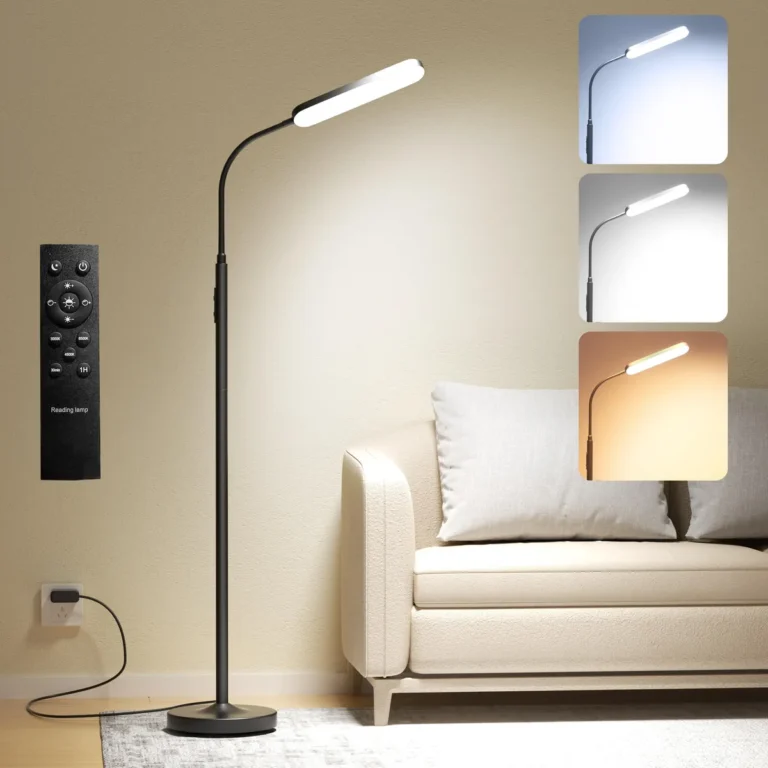
Image source: Web (Bing) / mumble.nationalgeographic.com (Web image (fair-use with source credit))
Quick Answer
The floor lamp inverse square law explained simply: light brightness drops rapidly as distance from the source increases. Double the distance between you and your lamp, and illuminance falls to 1/4 of its original level. Triple that distance, and brightness drops to 1/9 of the original.
This rule applies to all omnidirectional floor lamp light sources. Adjusting lamp position is often more effective than swapping to a higher-wattage bulb.
What the Inverse Square Law Actually Means for Your Floor Lamp’s Brightness
The inverse square law is a basic physics principle that describes how light spreads outward from a point source, like a standard floor lamp bulb. As light travels away from the bulb, it spreads over a larger and larger area, so the amount of light hitting any given surface drops off quickly. This is not a quirk of floor lamps specifically, it applies to all omnidirectional light sources, from table lamps to streetlights.
The math is simple, even if you haven’t taken a physics class. Illuminance, measured in lux, is inversely proportional to the square of the distance between the light source and the surface you’re lighting. That means if you double the distance from your lamp to your reading chair, the lux hitting the chair drops to 1/4 of its original level.
Triple the distance, and it falls to 1/9 of the original.
Let’s put that in real terms. A 1000-lumen LED floor lamp placed 3 feet from your reading nook delivers roughly 111 lux of illuminance. Move that same lamp 6 feet away, and you’re down to ~28 lux.
Per Illuminating Engineering Society (IES) standards, reading tasks require 300 to 500 lux to avoid eye strain. That same lamp would need to be less than 2.5 feet from your chair to hit that target, which is almost never practical for a floor lamp.
This is why so many people assume their new floor lamp is "defective" when it feels dim. The bulb is working exactly as it should, it’s just too far away to deliver usable light for your task. A small position adjustment often makes a far bigger difference than swapping to a higher-wattage bulb.
Visual Breakdown of Floor Lamp Light Falloff at Different Distances
If you’ve ever tried to picture how light spreads from a floor lamp, the diagram below makes the inverse square law click instantly. It shows three identical 1000-lumen LED floor lamps placed 3 feet, 6 feet, and 9 feet from a flat reading surface, with measured lux levels labeled for each distance.

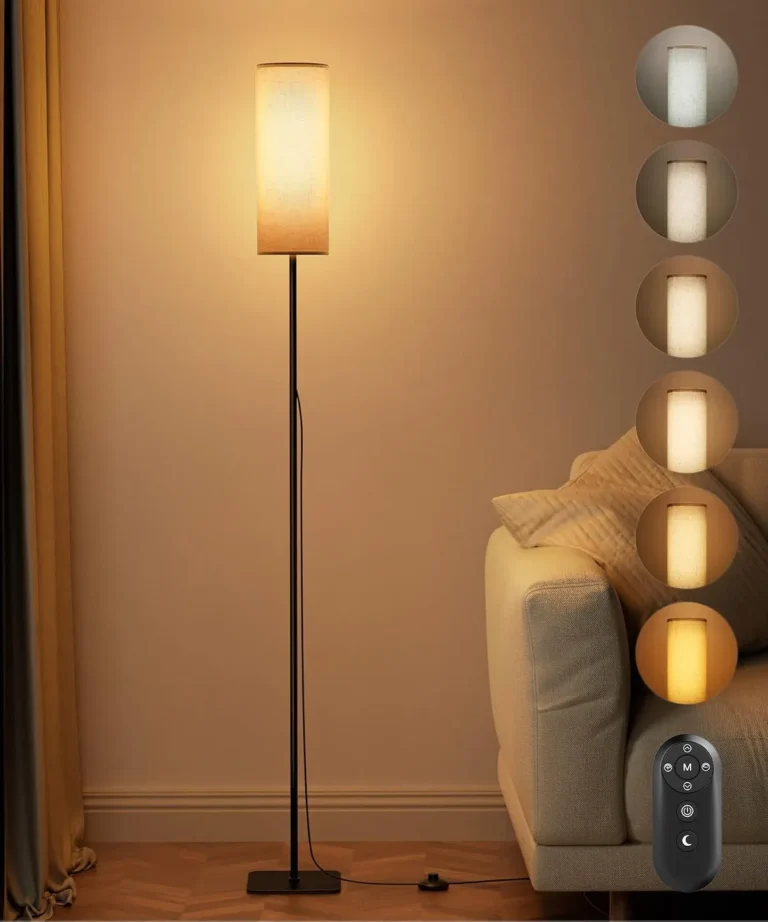
Image source: Web (Bing) / ledwatcher.com (Web image (fair-use with source credit))
Notice how the circle of light gets larger as distance increases, but the brightness per square inch drops drastically. At 3 feet, the lamp delivers ~111 lux to the surface. At 6 feet, that same light is spread over four times the area, so illuminance drops to ~28 lux.
At 9 feet, it’s spread over nine times the area, delivering just ~12 lux.
This visual also makes clear why "more lumens" isn’t always the fix for dim lighting. If you can’t move your floor lamp closer to your seating, you’d need a 9000-lumen bulb to get the same 111 lux at 9 feet. That’s brighter than most standard household fixtures and will cause harsh glare on nearby surfaces.
For omnidirectional torchiere floor lamps that shoot light upward, the falloff pattern looks slightly different, but the core inverse square rule still applies to the light hitting your target surface after it bounces off the ceiling.
How Floor Lamp Design Changes How the Inverse Square Law Applies
The inverse square law is a constant for point light sources, but your floor lamp’s design changes how that rule plays out in your space. Shade type, diffuser material, and head adjustability all shift how light spreads, how much reaches your target surface, and how fast brightness drops with distance.
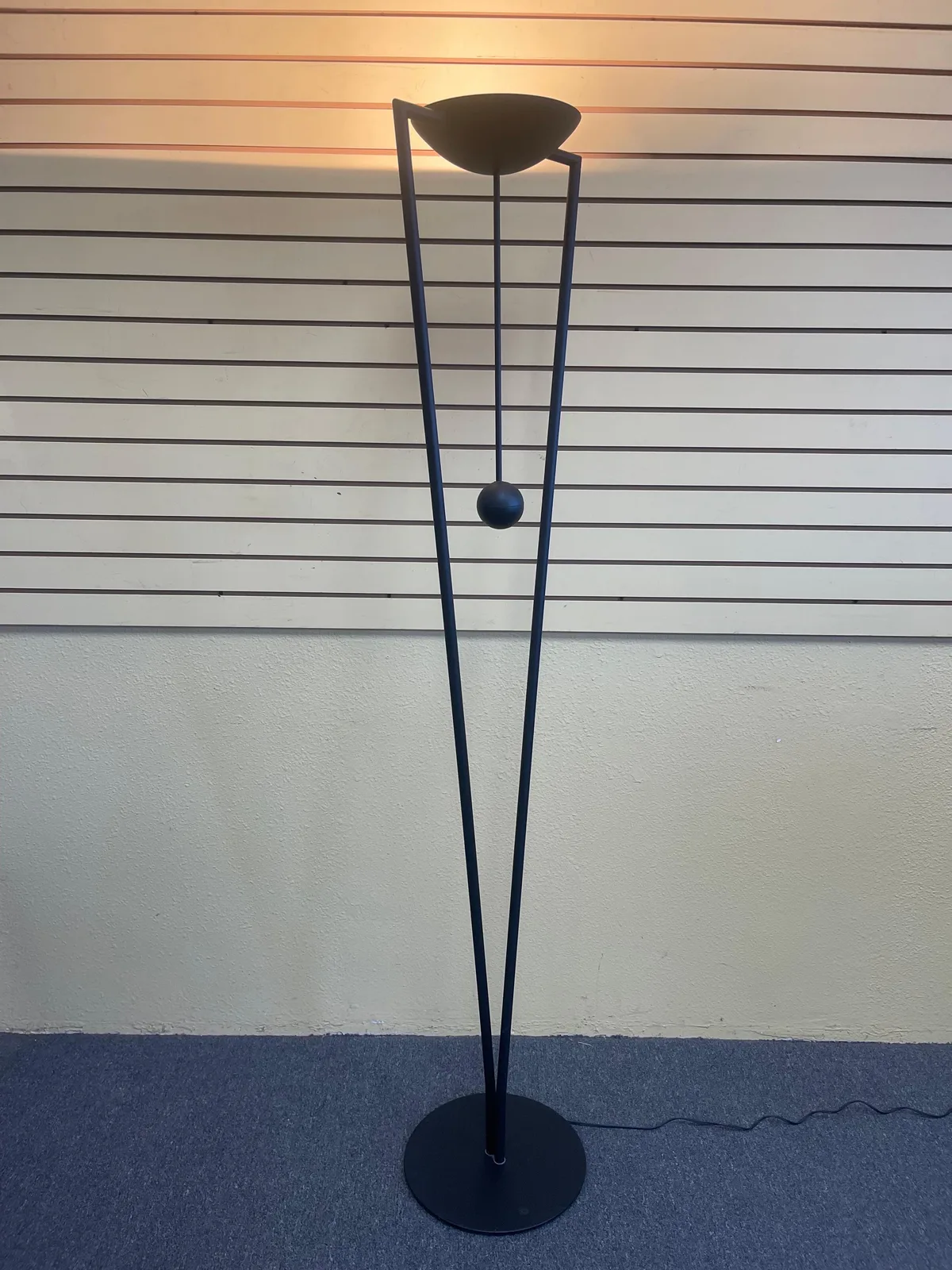
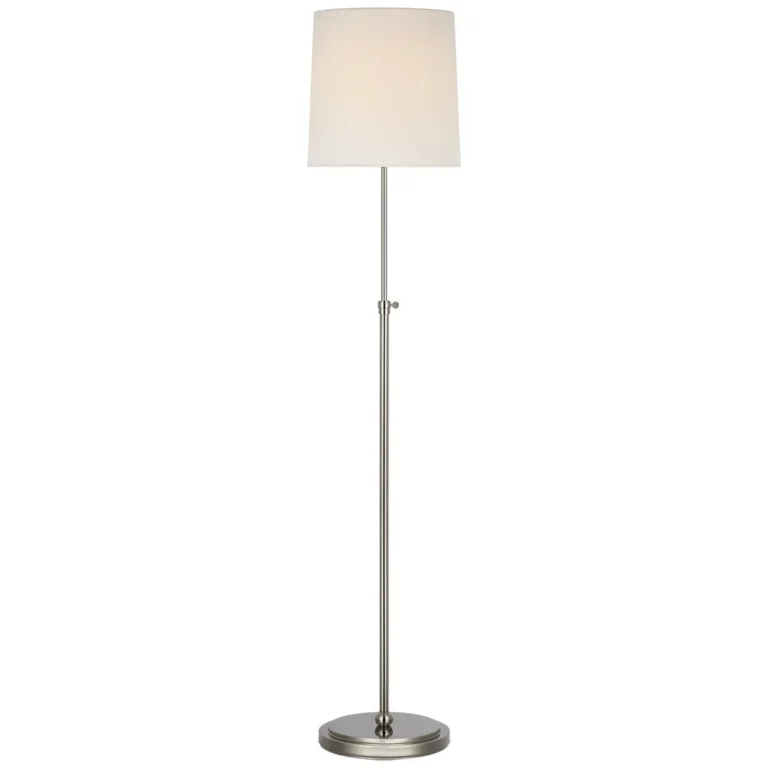
Image source: Web (Bing) / 1stdibs.com (Web image (fair-use with source credit))
The biggest variable is your lamp’s shade. An open-weave fabric shade lets light spread in all directions, so the standard inverse square law applies directly to the light hitting your seating area. An opaque solid shade blocks 20 to 40% of your bulb’s total lumen output, and concentrates the remaining light into a narrow beam.
That beam will stay brighter at longer distances than an open shade, but only if it’s aimed directly at your target.
Frosted diffusers and focused reflector shades, common on reading floor lamps, spread light over a wider area than a narrow beam, but with lower peak brightness. The table below breaks down how different shade types change light falloff:
| Shade Type | Light Spread | Effect on Inverse Square Law Falloff |
|---|---|---|
| Open-weave fabric | Wide, omnidirectional | Follows standard inverse square law closely; light spreads evenly in all directions from the source |
| Opaque solid shade | Narrow, directional | Blocks 20-40% of total lumens; falloff is slower within the focused beam but drops off sharply outside the beam area |
| Frosted diffuser | Soft, broad directional | Spreads light over a wider area than a focused beam; peak lux is lower but illuminance is more consistent at moderate distances |
| Focused reflector (reading lamp) | Narrow 15-30 degree beam | Concentrates light in a small area; falloff is slower within the beam but illuminance drops to near-zero outside the beam cone |
Adjustable floor lamp heads also change the equation. Tilting the head down to aim light directly at your reading chair reduces the effective distance between the source and your target, boosting illuminance without changing the bulb or moving the lamp base. Most mid-range floor lamps as of 2026 offer at least 90 degrees of head swivel and 30 degrees of tilt for this exact purpose.
Step-by-Step: Position Your Floor Lamp Using Inverse Square Law Rules
You don’t need a physics degree to use the inverse square law to get better floor lamp lighting. Just follow these steps to position your lamp for maximum usable brightness, no guesswork required.

Image source: Web (Bing) / trivia.elpopular.pe (Web image (fair-use with source credit))
- Define your task and required lux level. Per IES standards, reading and close work need 300 to 500 lux, while ambient living room lighting needs 100 to 200 lux. Write down your target range first.
- Measure the straight-line distance from your planned lamp base location to the center of your target area (your reading chair, desk, etc.). Use a tape measure for accuracy, don’t estimate.
- Note your floor lamp’s total lumen output, which is printed on the bulb or listed in the manufacturer’s spec sheet. Most standard LED floor lamps output 800 to 1600 lumens.
- Estimate your current illuminance using the inverse square ratio: if you double the distance from your lamp to your target, brightness drops to 1/4 of the original level. Triple the distance, and it drops to 1/9. For example, a 1200-lumen lamp that gives 400 lux at 3 feet will only give ~100 lux at 6 feet, which is fine for ambient light but too dim for reading.
- Adjust your lamp’s position or head angle to hit your target lux range. Move the base 1 to 2 feet closer to boost brightness, or tilt the head down to reduce the effective distance to your target. If you’re getting glare on seating areas, move the base back or angle the head away from eye level.
- Test the illuminance at your target surface with a handheld lux meter or calibrated smartphone app to confirm you’re in your target range. Most consumer lux meters have a ±10% margin of error, so aim for the middle of your target range to account for that.
Real Floor Lamp Placement Examples for Reading Nooks, Living Rooms, and Home Offices
The inverse square law plays out differently in every room, so real-world placement examples help you apply the rules to your space. For a standard 12 by 15 foot living room with a 1000-lumen LED floor lamp, place the base 4 to 5 feet from your primary seating area for ambient lighting. That distance delivers 40 to 63 lux at seating, which hits the 100 to 200 lux IES target for ambient use.
For a reading nook with a 1500-lumen focused reading lamp, place the base 2.5 to 3 feet from the chair. Aim the head directly at your book at a 30-degree downward angle to reduce effective distance. This setup delivers 300 to 500 lux at page level, the ideal range for avoiding eye strain from poor reading lighting.
In a home office with a dual-head floor lamp, position the base 3 feet from your desk. Angle one head at your keyboard and the other at your monitor to cut glare from screens. A 1200-lumen lamp at this distance delivers 133 lux at desk level, which is sufficient for task work when paired with standard overhead lighting.
For small apartments where floor lamps double as ambient and task lighting, choose a model with an adjustable head and frosted diffuser. Place the base 3.5 feet from your main seating area, and tilt the head down for reading when needed. This flexible setup avoids the need for multiple lamps, saving space and reducing electricity use.
Frequently Asked Questions About Floor Lamp Light Falloff
Why does my floor lamp feel dimmer the farther I sit from it?
This is the inverse square law in action. As distance between you and the lamp doubles, illuminance drops to 1/4 of its original level. A 1000-lumen lamp that gives 100 lux at 3 feet will only give 25 lux at 6 feet, which is too dim for reading or detailed work.
Does the inverse square law apply to all floor lamp types?
It applies to all omnidirectional point light sources, including most standard floor lamps. Directional reading lamps with focused beams follow a modified version of the rule, with slower falloff within the beam cone but near-zero light outside the beam area.
How can I make my floor lamp brighter without buying a new bulb?
Move the lamp 1 to 2 feet closer to your target area, or tilt the head down to reduce the effective distance. Swapping an opaque shade for an open or frosted alternative also increases usable light spread by 10 to 30% in most cases, per manufacturer testing. If these steps don’t work, our guide to fixing dim floor lamps covers other common causes.
What’s the best distance for a floor lamp next to a reading chair?
For most 800 to 1600 lumen LED floor lamps, place the base 2.5 to 3 feet from the chair, with the head aimed directly at your reading material at a 30-degree downward angle. This delivers 300 to 500 lux, the IES-recommended range for reading to avoid eye strain.
Do LED floor lamps follow the inverse square law the same way as incandescent bulbs?
Yes, the inverse square law applies to all light sources regardless of bulb type. The only difference is that LED bulbs produce more lumens per watt, so you can get the same illuminance at a given distance with less power, but the falloff rate with distance is identical.